Our approach
Find the value first. Then recover it.
What works is codified into one method, the Morphis Value Engine. It was built from decades of transformation work and has been used across technology and professional services businesses. A small senior team runs it, with AI doing the heavy analysis.
The Morphis Diagnostic finds the value. The Morphis Value Engine recovers it, phase by phase, returning more than it costs.
AI will not fix broken operating models. It will amplify them. For us, AI is how we work, not what we sell. It turns interview notes and your data into structured analysis, so a small team does in weeks what a larger one would take months to do, and senior people make every judgement.
What you can hold us to
Commitments we put in writing.
The method is why we can make these commitments, and why we're comfortable being held to them. Every one goes into the statement of work.
Fixed prices for defined results
The Diagnostic has one fixed price. Every phase after it is priced up front, with defined outcomes and a defined timeline.
Done by the people you meet
There's no junior team behind the pitch. The senior people you meet do the work, from the first meeting to the final recommendation.
Honest about fit
We'll give you an honest view of whether we're the right starting point for your firm. If we're not, we'll tell you.
A fee that shrinks
Our people hand their roles to yours as they're ready, and our fee narrows. Unused contingency comes back to you.
Yours to keep
You don't just get the outputs. You get the capability that produced them.
Step 1
The first conversation
The first real step is a conversation, and it needs no preparation. Tell us about the decision in front of you, or the investment just made. We'll listen, ask the right questions, and give you an honest view of whether the Diagnostic is the right starting point for your firm. If it isn't, we'll tell you that too.
Step 2: The Morphis Diagnostic
Know where your value is going, and what to do about it.
A focused review of one area, investment or problem in your firm. Six weeks, one fixed price, and an answer the partnership can act on.
The Diagnostic is £75,000, fixed. Our unique process and AI-assisted approach packs more effort in for much less than half what the UK’s largest consultancies would charge. If the Diagnostic doesn't find opportunities worth more than its fee, we'll tell you and offer a pro-rata refund.
Which number in your management pack hasn't moved in two years? The cost of doing nothing rarely appears in a report. It gets absorbed, worked around and quietly accepted.
The Diagnostic looks at a single area, investment or problem rather than the whole firm. That focus is what makes six weeks achievable. We analyse all the data for the area of focus, not a sample, so you see what interviews alone might miss, and two senior people make every judgement. AI does the heavy lifting, which is why it costs well under a comparable review done without AI. It works as well for a firm recovering value from past spend as for one about to commit to a major investment.
The Diagnostic is insurance on the bigger decision.
How the six weeks run
- Week 1
Define the focus
- Understand your key challenges and objectives
- Agree the scope: one area, investment or problem
- Weeks 1 to 2
Rapid insight
- Stakeholder interviews
- Data review and analysis
- Baseline performance agreed
- Weeks 2 to 3
Identify value gaps
- Where value is lost or constrained
- Root causes
- Size of the impact
- Weeks 3 to 4
Prioritise opportunities
- Value weighed against effort
- Quick wins identified
- Ranked opportunity backlog
- Weeks 4 to 6
Align and recommend
- Executive narrative
- Findings and recommendations
- Next steps agreed
Scroll sideways to see all five steps.
What you'll be able to do afterwards
See where value is being lost
An evidence-based view of where value is created, constrained and lost in the area we looked at, set against an agreed baseline.
Act on the right things first
Opportunities ranked by value, effort and speed to impact, so the first money you spend is the best-returning.
Show progress early
Quick wins: targeted actions that produce visible improvement while the bigger work is planned.
Take a plan to the partnership
A phased Value Recovery Roadmap, with numbers behind it: what to do now, what next, and how to scale.
Spend on technology with confidence
Where existing tools can do more, where AI is relevant, where it's premature, and what needs to be in place first.
Tell one story
An executive narrative linking current performance, value leakage and the route to improvement.
Six defined outputs. What happens after that is collaborative work, and we'll be clear about which parts depend on you.
You also get an honest read. We'll challenge what we find and put the uncomfortable things in front of you. What's culturally acceptable is your call, and we'll be clear about what each choice costs and offers. The outputs are yours to act on, with us or without us.
Step 3: The Morphis Value Engine
The Diagnostic finds the value. The Value Engine recovers it.
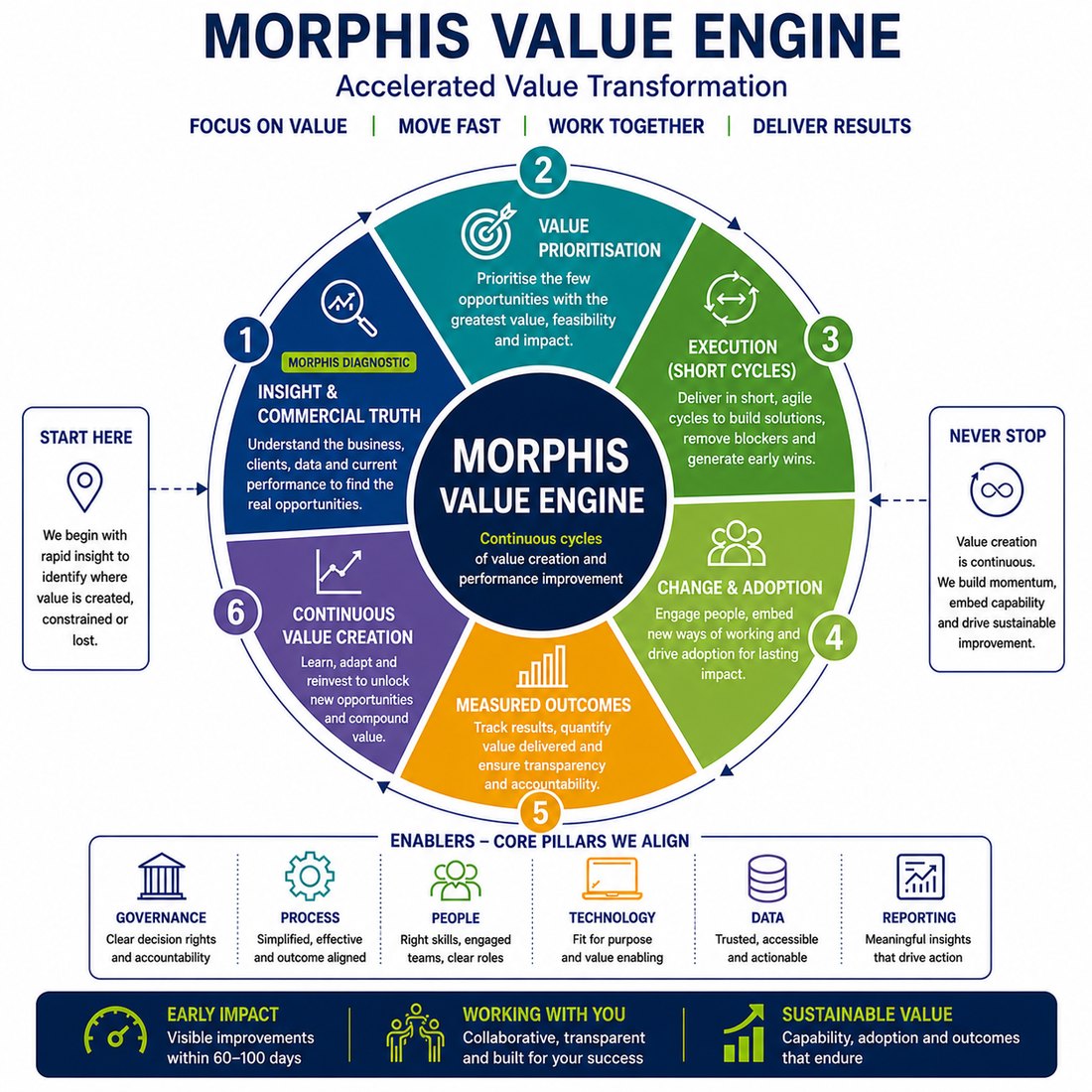
The Value Engine is a six-stage cycle of short delivery phases, each priced up front with defined outcomes and a defined timeline. Each phase stands alone, so you can stop after any of them. Change and adoption run through every stage, because a better process nobody uses returns nothing. Measured outcomes is a stage in its own right: it's where the baseline from the Diagnostic shows tangible results.
What it means for your firm
- Visible results early: measurable improvement within 60 to 100 days.
- No long programmes: short, focused cycles you can stop, reshape or extend.
- Change that sticks: adoption built in from the first conversation.
- The whole picture: each phase looks across governance, process, people, technology, and data & reporting.
- Costs that fall over time: our team shrinks as your own capability grows.
- Capability you keep, not a dependency you inherit.
A fee that shrinks
We start with the team needed to move at pace, then hand roles to your own people as they're ready. Our commercial interest points towards you needing us less.
How you'll see the return
Before any work starts, we agree the measures with you. The Diagnostic sets the baseline, and every phase after it reports against that baseline, so the partnership sees the return in its own management information.
Transformation is not a single event. It's an engine. Once running, it creates more value than it costs to run.
In practice
Worked example: AI that didn't deliver what clients asked for
Built from discussions with partners at several law firms about their AI drafting roll-outs. The pattern is real; the figures are modelled.
The situation
A £65m firm's corporate clients ask it to use AI to deliver their work faster and cheaper. The firm rolls out AI drafting, and drafting becomes 68% faster, while partner review time rises. Because partner time costs more, each agreement now costs more to deliver, even though matters finish 11% sooner. Fees don't move, so matter profitability falls, and on lower-margin work some matters can tip into write-off while client satisfaction stays flat. The partnership asks the question the Diagnostic is built to answer: why hasn't the investment delivered what clients asked for?
What the Diagnostic looks at
The practice's whole value stream, from instruction to signed agreement and the bill that follows. Matter and time data for all 320 agreements a year, with 30 traced stage by stage alongside the partners and associates who did the work.
What it finds
Thirteen opportunities, from matter intake to pricing, ranked by value and speed to impact. The largest explains the gap. Partners used to shape a draft over two or three rounds, so they knew it by the time they signed. AI removed those rounds. Drafts now arrive complete but unfamiliar, and partners spend an extra 4.8 hours on each one checking what they're signing off. Set against the associate time saved, each agreement costs about £530 more to deliver, roughly £170,000 a year (at assumed charge-out rates of £450 an hour for partners and £275 for associates). At London partner rates the gap is wider still. The friction hasn't gone; it has moved from drafting to review, and to more expensive people.
What it recommends first
Three changes: a 30-minute partner briefing before drafting starts; firm-specific templates so drafts need less checking; and a client message built on quality rather than speed.
The value
Recovering three partner hours per agreement means AI finally does what it was bought to do. Each agreement now costs less to deliver than it did before AI, not more. Across the year, that's about £432,000 of partner time back rather than written off. The wider plan, including fixed fees for standard agreements, adds £400,000 to £700,000. Most importantly, the time saved now reaches clients as faster matters and lower fees, which is what they asked for in the first place.
How it's measured
Partner review hours per agreement, cost to deliver each agreement, write-offs, end-to-end matter time and realisation on fixed-fee work, each tracked against the Diagnostic baseline.
Questions you may ask us
Where does our data go?
We work from your management information, such as utilisation, lock-up and profitability, never your clients' files. It stays in a secure workspace seen only by our team, on enterprise AI terms that never use it to train AI models. Afterwards we return or delete it, keeping only anonymised figures that can't identify your firm.
What if the opportunities are smaller than the fee?
We'll say so plainly and offer a pro-rata refund, measured against the baseline we agree with your sponsor in week two.
What do you need from us?
A day-to-day coordinator for about an hour most days; a sponsor and a few members of the team in focus for a handful of hours across the six weeks; and data from Finance and IT.
Why not hire someone instead?
A new hire takes six to nine months to become effective, joins without a pattern of what works across comparable firms, and carries the political exposure of a new arrival recommending change. The Diagnostic produces a prioritised, evidence-based action plan in six weeks, at a fixed price, with no recruitment risk.
Can we stop after the Diagnostic?
Yes. You can stop after the Diagnostic, or after any phase that follows it. Everything we produce is yours to keep.